Monday, September 10, 2007

Bog Mummies Yield Secrets


Source:
Science Daily — Human remains yield secrets. Researchers, including Dr. Heather Gill-Robinson, assistant professor of anthropology at North Dakota State University, are now probing the secrets of 'bog mummies' some dating back 2000 years, preserved from the Iron Age with amazing detail in peat bogs of Europe.
Bog mummies have particularly interesting stories to tell. Physical anthropologists draw conclusions from the eerily preserved hair, leathery skin and other features that emerge from the bogs.
During the Iron Age from approximately 500BC to 500AD, bodies were often cremated, often leading experts to believe that mummies uniquely preserved by the bogs were people who met their demise through particularly violent means or were used as sacrifices, although there are numerous possible other explanations. A violent demise was thought to be the case for a mummy known as Windeby Girl, studied by Dr. Gill-Robinson. Discovered in northern Germany in 1952, experts thought she may have been an adulteress whose head was shaved, after which she was blindfolded and drowned in the bog.
But, on closer inspection, Heather Gill-Robinson of North Dakota State University determined that the Windeby Girl was actually more likely to have been a young man. He may have lost his hair when archaeologists’ trowels dug up the body. Physical examination of the mummy showed that growth interruptions in the bones of the specimen indicated a sick young man who may have died from natural causes.
The water and other substances in peat bogs create a natural preservative for the bodies found in them, though Dr. Gill-Robinson says researchers are still trying to determine why. The lack of oxygen, antimicrobial action and the sphagnum found in bogs seem to conspire to preserve the bodies tossed into them thousands of years ago. Bogs were once seen as homes for gods and outcast spirits.
But increasingly sophisticated computer programs and use of medical technology such as CT scans, radiocarbon dating and 3-D imaging have resulted in additional and potentially more accurate answers to the mysteries of the peat bog mummies. In her research, which includes the study of other mummies in addition to “Windeby Girl,” Gill-Robinson can also determine other details such as what they ate and their possible occupations.
The research being conducted at NDSU also gives students an opportunity to learn more about physical anthropology, according to Gill-Robinson. Two recent NDSU graduates, for example, analyzed CT scans of mummy specimens for a year and four more students are involved in image analysis projects this year. The mummies studied in Gill-Robinson’s research were found between 1871 and 1960. She has studied them for the past four years.
“Detailed analysis of the bog bodies provides us a window into cultures, heritage and the way people lived thousands of years ago,” says Gill-Robinson. “When we think we may have discovered something new about a mummy, we can re-visit it several years later and with new technology, refine our research results. In these cases, we need to present a revised interpretation to the public. Communities where discoveries are made have a high level of interest in what is found. Respectfully addressing folklore surrounding such discoveries in communities also plays a role.”
Gill-Robinson’s areas of research interest have focused on a collection of seven bodies (six mummies and one skeleton) from peat bogs in northern Germany. After a receiving a three-month research grant from the German Academic Exchange Service, Bonn, Germany, Gill-Robinson spent the summer exploring aspects of peat bog mummies in conjunction with Stiftung Schleswig-Holsteinische Landesmuseen Schloss Gottorf, a museum in Schleswig, Germany. Her research was included in a recent National Geographic article in September of 2007 and previously cited in the article, “Rehabilitation of a Moorland Corpse,” in Abenteuer Archaeologie, a German popular press archaeology magazine.
Note: This story has been adapted from a news release issued by North Dakota State University.

Fausto Intilla

Thursday, September 6, 2007

Ancient Human DNA Extracted From Yucca Leaves Spat Out


Source:

Science Daily — In a groundbreaking study, two Harvard scientists have for the first time extracted human DNA from ancient artifacts. The work potentially opens up a new universe of sources for ancient genetic material, which is used to map human migrations in prehistoric times.
Before this, archaeologists could only get ancient DNA from relics of the human body itself, including prehistoric teeth, bones, fossilized feces, or — rarely — preserved flesh. Such sources of DNA are hard to find, poorly preserved, or unavailable because of cultural and legal barriers.
By contrast, the genetic material used in the Harvard study came from two types of artifacts — 800 to 2,400 years old — that are found by the hundreds at archaeological sites in the American Southwest.
“Quids” — small fibrous bundles of stripped yucca leaves — are the spit-out remnants of a kind of ancient chewing gum. Cells from long-dried saliva yield usable DNA. And “aprons” were thong-like woven garments worn by women. They are stained with traces of apparent menstrual blood, a source of DNA.
The Harvard study, featured in the summer 2007 issue of the Journal of Field Archaeology, “opens up the possibility of utilizing a much larger variety of human-handled artifacts” for DNA evidence, said project co-director Steven LeBlanc, director of collections at Harvard’s Peabody Museum of Archaeology and Ethnology.
Among the likely future sources of ancient DNA, he said, are “sandals, textiles, and cane cigarettes,” a reedlike smoke favored by early humans. LeBlanc’s co-director in the project was Thomas Benjamin, a professor of pathology at Harvard Medical School.
LeBlanc and others sampled 48 quids from four Southwestern archaeological sites — some of them on Harvard museum shelves for nearly 100 years — and 18 aprons found in Canyon de Chelly, a National Park Service site in Arizona still occupied by the Navajo Nation.
Aprons, and especially quids, are very common in archaeological collections, and are recovered from rock shelters or caves in the Southwest, Utah, Texas, California, and central Mexico. The DNA is preserved by the extreme dryness of such sites.
The Harvard study brings other good news for historians of ancient times. LeBlanc said the DNA captured from quids and aprons shows — in a preliminary way — that early farming populations in the Southwest descended from farmers in what is now central Mexico. That helps answer an old question among those who study the ancient Southwest: Was the idea of farming imported, or was it adopted by indigenous populations?
More broadly, archaeologists interested in migration patterns anywhere now have a new source for the DNA that can be used to track the movement of ancient people — though LeBlanc cautioned that the methods have to be retested and refined.
The origins of the earliest North American farmers are still officially a puzzle, and center on a now-lost tribe known as the Western Basketmakers. More than 2,000 years ago, these indigenous Americans started growing corn in what is now southeastern Utah and northern Arizona.
In what is now a boon to archaeologists who look at DNA, early farmers rested in the shade of rock formations, and spit out quids of chewed yucca leaves.
“The team was as surprised as everyone else that we could learn something about a possible migration over 2,000 years ago from ancient spit,” said LeBlanc. “Every artifact that we recover from such ancient sites now needs to be thought of in a new light, and handled in new ways, to ensure we preserve this DNA for future studies.”
To make sure the DNA was from ancient farmers and not from modern handlers, samples were taken from the cores of the quids and not from their surfaces.
Peabody Museum experts say future studies of ancient DNA from quids, aprons, and other appropriate artifacts are needed to test and refine Harvard’s preliminary findings.
The study was a collaborative project. Harvard researchers worked with genetic anthropologist Shawn W. Carlyle at the University of Utah; pathologist Lori S. Cobb Kreisman at Case Western Reserve University School of Medicine; curator Anna N. Dhody at the Mütter Museum at the College of Physicians of Philadelphia; anthropologist Brian M. Kemp at Vanderbilt University; and Francis E. Smiley, an anthropologist at Northern Arizona University. Ancient DNA expert David Glenn Smith offered his advice and the use of his laboratory at the University of California, Davis.
Some of the artifacts used in the DNA analysis were from collections at the Brooklyn Museum of Art, the Southwest Museum, and Northern Arizona University.
The study was supported by the Provost’s Fund for Interfaculty Collaboration at Harvard University and by the Peabody Museum of Archaeology and Ethnology.
Note: This story has been adapted from a news release issued by Harvard University.

Fausto Intilla

Wednesday, September 5, 2007

First Beehives In Ancient Near East Discovered


Source:

Science Daily — Archaeological proof of the Biblical description of Israel really as "the land of milk and honey" (or at least the latter) has been uncovered by researchers from the Hebrew University of Jerusalem Institute of Archaeology.
Amihai Mazar, Eleazar L. Sukenik Professor of Archaeology at the Hebrew University, revealed that the first apiary (beehive colony) dating from the Biblical period has been found in excavations he directed this summer at Tel Rehov in Israel's Beth Shean Valley. This is the earliest apiary to be revealed to date in an archaeological excavation anywhere in the ancient Near East, said Prof. Mazar. It dates from the 10th to early 9th centuries B.C.E.
Tel Rehov is believed to have been one of the most important cities of Israel during the Israelite monarchy. The beehives there were found in the center of a built-up area there that has been excavated since 1997 by Dr. Nava Panitz-Cohen of the Hebrew University. Three rows of beehives were found in the apiary, containing more than 30 hives. It is estimated, however, based on excavations to date, that in all the total area would have contained some 100 beehives.
Each row contained at least three tiers of hives, each of which is a cylinder composed of unbaked clay and dry straw, around 80 centimeters long and 40 centimeters in diameter.
One end of the cylinder was closed and had a small hole in it, which allowed for the entry and exit of the bees. The opposite end was covered with a clay lid that could be removed when the beekeeper extracted the honeycombs. Experienced beekeepers and scholars who visited the site estimated that as much as half a ton of honey could be culled each year from these hives.
Prof. Mazar emphasizes the uniqueness of this latest find by pointing out that actual beehives have never been discovered at any site in the ancient Near East. While fired ceramic vessels that served as beehives are known in the Hellenistic and Roman periods, none were found in situ, and beekeeping on an industrial level such as the apiary at Tel Rehov is hitherto unknown in the archaeological record. Pictorial depictions of apiaries are known from Pharaonic Egypt, showing extraction of honey from stacked cylinders which are very similar to those found at Tel Rehov.
Cylindrical clay beehives placed in horizontal rows, similar to those found at Tel Rehov, are well-known in numerous contemporary traditional cultures in Arab villages in Israel, as well as throughout the Mediterranean. The various products of beehives are put to diverse use: the honey is, of course, a delicacy, but is also known for its medicinal and cultic value. Beeswax was also utilized in the metal and leather industries, as well as for writing material when coated on wooden tablets.
The term "honey" appears 55 times in the Bible, 16 of which as part of the image of Israel as "the land of milk and honey". It is commonly believed that the term refers to honey produced from fruits such as dates and figs. Bees' honey, on the other hand, is mentioned explicitly only twice, both related to wild bees. The first instance is how Samson culled bees' honey from inside the corpse of the lion in the Soreq Valley (Judges 14: 8-9). The second case is the story of Jonathan, King Saul's son, who dipped his hand into a honeycomb during the battle of Mikhmash (Samuel I 14:27).
While the Bible tells us nothing about beekeeping in Israel at that time, the discovery of the apiary at Tel Rehov indicates that beekeeping and the extraction of bees' honey and honeycomb was a highly developed industry as early as the First Temple period. Thus, it is possible that the term "honey" in the Bible indeed pertains to bees' honey.
Cultic objects were also found in the apiary, including a four-horned altar adorned with figures of naked fertility goddesses, as well as an elaborately painted chalice. This could be evidence of deviant cultic practices by the ancient Israelites related to the production of honey and beeswax.
Study of the beehives found at Tel Rehov is being conducted with the participation of various researchers. Dr. Guy Bloch of the Silberman Institute of Life Sciences of the Hebrew University is studying the biological aspects of the finds; he already discovered parts of bees' bodies in the remains of honeycomb extracted from inside the hives. Dr. Dvori Namdar of the Weizmann Institute of Science succeeded in identifying beeswax molecules from the walls of the beehives, and Prof. Mina Evron from Haifa University is analyzing the pollen remains in the hives.
Dating of the beehives was done by measuring the decaying of the 14C isotope in organic materials, using grains of wheat found next to the beehives. This grain was dated at the laboratory of Groningen University in Holland to the period between the mid-10th century B.C.E. until the early 9th century B.C.E. This is the time period attributed to the reign of King Solomon and the first kings of the northern Kingdom of Israel following the division of the monarchy. The city of Rehov is indeed mentioned in an Egyptian inscription dating to the time of the Pharaoh Shoshenq I (Biblical Shishak), whom the Bible notes as the contemporary of King Solomon and who invaded Israel following that monarch's death.
A particularly fascinating find at the site is an inscription on a ceramic storage jar found near the beehives that reads "To nmsh". This name was also found inscribed on another storage jar from a slightly later occupation level at Tel Rehov, dated to the time of the Omride Dynasty in the 9th century BCE. Moreover, this same name was found on a contemporary jar from nearby Tel Amal, situated in the Gan HaShelosha National Park (Sachne).
The name "Nimshi" is known in the Bible as the name of the father and in several verses the grandfather of Israelite King Jehu, the founder of the dynasty that usurped power from the Omrides (II Kings: 9-12). It is possible that the discovery of three inscriptions bearing this name in the same region and dating to the same period indicates that Jehu's family originated from the Beth Shean Valley and possibly even from the large city located at Tel Rehov. The large apiary discovered at the site might have belonged to this illustrious local clan.
The excavations at Tel Rehov were supported by John Camp from Minneapolis in the U.S. with the participation of archaeological students from the Hebrew University of Jerusalem and numerous volunteers.
Note: This story has been adapted from a news release issued by The Hebrew University of Jerusalem.

Fausto Intilla

Sunday, September 2, 2007

'Kitchen science' reveals dinosaurs died in agony


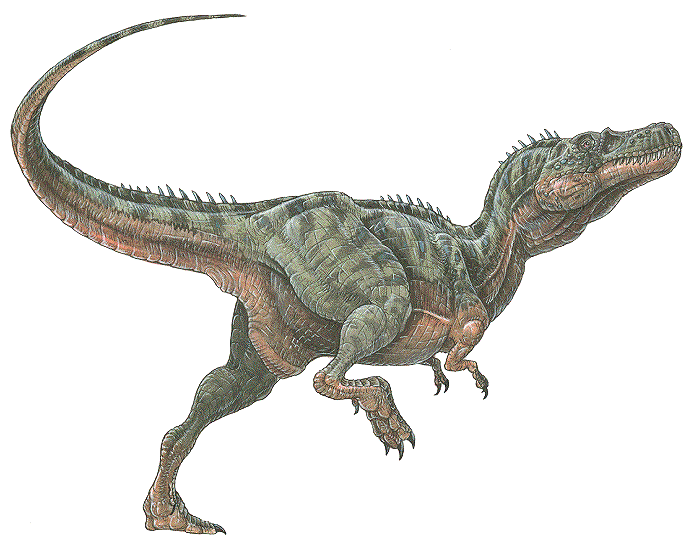
A dinosaur mystery that puzzled paleontologists for nearly a century has been solved by a pound of beef tendons from a butcher, a collection of dead hawks and a brace of frozen quail, two investigative scientists in Berkeley and Idaho say.
The puzzle: Why were fossils of those ancient creatures so often discovered buried with their heads, necks and feet arched bizarrely backward into a distorted posture unlike anything seen alive?
The answer: Kevin Padian, a noted dinosaur expert and curator of the Museum of Paleontology at UC Berkeley, and Cynthia Marshall Faux, a veterinarian and paleontologist at the Museum of the Rockies in Bozeman, Mont., say the beasts were suffering in violent death throes as they perished -- asphyxiated by volcanic gases or ash falls, poisoned by unknown toxins or drowned in swamps or deepwater lakes.
It was knowledge of animals in veterinary clinics plus a few "kitchen science" experiments that led to this conclusion, say the researchers, and it should provide a new understanding of the dinosaurs' environments millions of years ago. It also adds support for the once-controversial claim that the ancient dinosaurs were all warm-blooded just as modern birds are, and unlike the ancestral crocodiles and lizards whose blood still runs cold today.
When paleontologists years ago were struck by the peculiar posture of most fossil dinosaur skeletons, they offered many explanations in their reports: The skeletons always developed that way after death, they said -- strong currents must have bent the bodies that way before sediments could bury them; or their necks were broken backward as a result of diving or falling into mud; or salts in evaporated water stiffened them into position after death; or dry air shriveled the tendons in their dead bodies until the skeletons bent; or it was all an example of rigor mortis -- the stiffening of any body that follows quickly after death.
It was Faux (pronounced Fox) who devised the experiments that solved the problem, Padian said. She is a vet turned paleontologist who also affiliated with Yale University's famed Peabody Museum of Natural History.
Based on her experience in animal clinics, she reasoned that the deformed posture of the dinosaurs seemed clearly due to damage to their central nervous systems before death, and she set about to test whether the idea held up for dinosaurs as well as modern animals.
Faux is a large-animal specialist who lives near Lewiston, Idaho, and at a nearby butcher's shop she bought a few pounds of beef tendons, dried some, salted some, soaked some, and showed that none shrank in any way that could possibly have distorted an animal skeleton.
For two months she dried the bodies of two red-tailed hawks euthanized at the Raptor Conservation Center in Bozeman and found no post-mortem movement at all. She immobilized the bodies of badly injured barn owls and falcons from the raptor center, and their muscles and tendons didn't move.
Finally, she bought two frozen quail from a commercial quail farm, thawed them, soaked them in a heavy salt solution, and observed their decomposing bodies for as long as two weeks. Their bones never took on that bizarre distorted posture like the fossil dinosaurs -- known in medicine as opisthotonus.
Opisthotonus during death occurs only in warm-blooded animals like birds and mammals today, but not in cold-blooded creatures, Padian said -- so this work offers new support for the idea that dinosaurs must have been warm-blooded too, he said.
Faux's detailed experimentation was truly persistent research, Padian said. It was, he said, "powerful kitchen science."
"The prevalent idea has been that these animals distorted posture occurred only after death with no scavenging of their bones, and then were somehow buried by currents of water and mud," Padian said. "Our study suggests that many of these animals died instead in places that were already inundated, and that they maintained their death postures as they were quickly buried."
And because many paleontologists have based inferences about dinosaur environments on the state of their skeletons in the rock layers where they are found, Padian said, some traditional views of "paleoenvironments" will now need some new thinking.
The work by Faux and Padian was published in the current issue of the journal Paleobiology.
E-mail David Perlman at dperlman@sfchronicle.com.
This article appeared on page A - 7 of the San Francisco Chronicle.

Fausto Intilla
www.oloscience.com

Big Bird dinosaur found


Fossil of new species scientists named Gigantoraptor discovered in the Gobi Desert
David Perlman, Chronicle Science Editor
Thursday, June 14, 2007

Xu Xing, a Chinese paleontologist, puzzled over the thigh bone of a monstrous new dinosaur he and his partners had discovered in the rich fossil beds of the Gobi Desert.
The bone was so big, he said in an e-mail to The Chronicle, that he thought he and his colleagues had merely found another of those familiar plant-eating, long-necked, semi-aquatic creatures called sauropods, well known in the evolutionary past of the dinosaur world.
Then he thought the bone most likely had come from a tyrannosaur -- perhaps the voracious and towering T. rex, the prime predator of fright movies.
But no, it wasn't T. rex at all; it was a fossil from the largest birdlike creature ever seen, Xu said. More than 26 feet long and 16 1/2 feet tall, it was a young adult that must have weighed at least a ton and a half when it was alive more than 70 million years ago, he said. It thrived in the late Cretaceous period only a few million years before all the dinosaurs on Earth became extinct.
"When I went back to my geologist colleague Lin Tan's lab to check the skeleton, I was shocked," Xu wrote in his e-mail. "I said to Tan, 'It is not a sauropod, it is not a tyrannosaurus, it is a tyrannosaurus-sized oviraptor. We have a gigantic chicken!' "
And that's the report the journal Nature is publishing today: the discovery of a creature Xu's team has named Gigantoraptor erlianensis, a giant birdlike dinosaur from the Gobi's Erlian basin, long known to science for its famous fossils and to prospectors for its vast oil reserves.
From the fossil record, the world's leading paleontologists are now sure that all modern birds are descended from the dinosaurs; in fact, the scientists often term birds "modern dinosaurs." And paleontologists, studying the fossils marking the evolution of birds during the age of dinosaurs, have observed that as the birdlike dinosaurs approached birdness, they seem to have evolved into smaller and smaller types.
So what's an enormous beast like Gigantoraptor doing among the avian world's ancestors?
It's a curious twist in the long up-and-down saga of evolution that has intrigued science ever since the Cambrian explosion of 500 million years ago, when the ancestors of countless familiar life forms emerged -- in the short span of 10 million years.
Said UC Berkeley's Kevin Padian, a leading expert on dinosaur evolution and curator of the university's Museum of Paleontology who has seen the report from Xu and Tan:
"We have dwarf sauropods, so why not giant oviraptors (the term means 'egg thief')? If resources are available, all animals will take the opportunity to increase their size. Dinosaurs can get small, and dinosaurs can get big, and the bigger ones grow faster than the little ones, because getting bigger fast can reduce the number of predators around.
"It all goes to show that when it comes to the diversity of dinosaurs, we're still just scratching the surface."
The details in the report by Xu and Tan are fascinating: "Growth lines" in one bone showed that the creature grew to adult size in only seven years -- faster than most other two-footed, meat-eating dinosaurs and "probably died in the eleventh year of life."
The animal had no teeth in its beak so its diet is a mystery, Xu said, because it had the relatively small head and long neck typical of plant-eaters, and the sharp claws of many meat-eaters.
And while the fossil-hunters found no evidence of feathers -- as many dinosaur species show -- the beast could well have had feathered arms and feathers on its tail, most likely for sexual display.
Finally, although most two-footed dinosaurs had stout legs to carry their weight, and short arms, Gigantoraptor's legs were relatively long and slender, and its arms were unusually long -- "more birdlike than its small relatives in many features," Xu said.
Mark Norell at the American Museum of Natural History has hunted dinosaur fossils with Xu in the Gobi Desert in the past but was not involved in this discovery. He studied the Gigantoraptor's fossil bones last year at Xu's Institute of Paleontology and Paleoanthropology in Beijing.
"It was really a surprise when I first saw it," Norell said in a telephone conversation. As dinosaurs evolved toward birds, they got smaller and smaller, their fossils show; until now, birdlike dinosaurs were at most 10 or 11 feet long -- certainly not 26 feet.
Paul Sereno, a paleontologist at the University of Chicago who read the report, called it "a big find, really exciting -- a class act."
"But what kind of environment on Earth was this animal adapted to?" he wondered. "It's off the charts, and with no teeth what did it eat? Did it use those long legs to escape from predators? It's clearly a pre-flight bird, but no one would have predicted its evolution, so the door seems open to a new way of living for a new kind of dinosaur."
E-mail David Perlman at dperlman@sfchronicle.com.
This article appeared on page A - 7 of the San Francisco Chronicle

Fausto Intilla
www.oloscience.com

The mystery of accidental Mexican mummies


Source:

By Dave Collins, Associated Press

HARTFORD, Conn. — People who lived in the mining town of Guanajuato, Mexico, more than a century ago left behind a scientific mother lode: their own accidentally mummified bodies.
Scientists are conducting what they say is the first intensive examination of more than 100 bodies mummified in the city, while stored in aboveground crypts from the mid-19th to mid-20th centuries.

The bodies from the Guanajuato's Museo de las Momias (Museum of the Mummies) are believed to be the largest mummy collection in the Western Hemisphere.
Guanajuato Mayor Eduardo Romero Hicks invited scientists from Texas State University and Quinnipiac University in Connecticut in to find out more about the people whose remains are on display at the museum.
"What we're hoping to do with the scientific research ... is that when you come to see the mummies it's going to be like meeting a person," said Ronald Beckett, a Quinnipiac cardiopulmonary sciences professor and former co-host of The Mummy Road Show on the National Geographic Channel.
"We're going to try and get these individuals to tell us their story, which can then be there on the display, so you're not just looking at an individual who was mummified by the crypts there in Guanajuato," Beckett said Thursday as researchers announced their preliminary findings in Hartford.
According to local legend, the bodies are so well preserved because the city's water is rich with minerals and sulfur. But the researchers believe the hot weather warmed the crypts and the bodies dried out.
The first mummy is believed to have been discovered in 1865, when the body of a French physician was removed from a cemetery crypt because a burial tax had not been paid. The cemetery began storing mummies in a nearby building, and a museum was opened in the late 1800s.
The scientists examined 22 mummies during a trip to Guanajuato in May and plan to return next year to look at the rest; no mummies were removed from the city. Funds are being provided by Quinnipiac, Guanajuato's government and the researchers themselves.
"The general picture that's coming out of this community is that these individuals were hardworking," Beckett said. "There was a lot of arthritis from wear and tear from hard work."
Researchers also found evidence of infectious diseases like tuberculosis, and the many mummified children were a reminder of the high infant and child mortality rates of the 1800s and early 1900s.
Among the mummies were an infant and a fetus that had both been cut open and closed with sutures, possibly indicating embalming or autopsies. No other mummies had signs of embalming.
A man and a woman who had appeared to have been hanged were found to have no internal damage to their throats. Beckett said the external markings on the mummies' throats may have been caused by the high-collared clothing in which they were buried.
Researchers are using various techniques to examine the mummies, including looking inside them with endoscopes, taking X-rays and measuring bones. They also hope DNA experts become interested and offer to analyze samples of hair and a placenta taken from the bodies.
Beckett and Quinnipiac colleague Gerald Conlogue first studied the mummies in 2001 for The Mummy Road Show, but Beckett said the latest research is the first-ever intensive examination of the collection.
The mayor, a medical doctor, said his goal is to find out as much as possible about the people who were mummified and treat the bodies with respect. He said no relatives of any of the mummies have been found or have come forward.
"They're not just a bunch of mummies lying around," Romero said. "If we have a body on display, I think he has a right to tell his story."

Fausto Intilla
www.oloscience.com

Saturday, September 1, 2007

When Bivalves Ruled The World


Source:

Science Daily — Before the worst mass extinction of life in Earth's history -- 252 million years ago -- ocean life was diverse and clam-like organisms called brachiopods dominated. After the calamity, when little else existed, a different kind of clam-like organism, called a bivalve, took over.
What can the separate fates of these two invertebrates tell scientists about surviving an extinction event?
A lot, says UWM paleoecologist Margaret Fraiser. Her research into this particular issue not only answers the question; it also supports a relatively new theory for the cause of the massive extinctions that occurred as the Permian period ended and the Triassic period began: toxic oceans created by too much atmospheric carbon dioxide (C02).
The theory is important because it could help scientists predict what would happen in the oceans during a modern "C02 event." And it could give them an idea of what recovery time would be.
Studying the recovering ecology is equally significant, says Fraiser. The evolution of surviving species in the aftermath of the mass extinction set the stage for dinosaurs to evolve later in the Triassic.
From air to water Fossil records suggest that trauma in the oceans actually began in the air.
"Estimates of the C02 in the atmosphere then were between six and 10 times greater than they are today," says Fraiser, an assistant professor of geosciences. It makes sense, she says. The largest continuous volcanic eruption on Earth -- known as the "Siberian Traps" -- had been pumping out C02 for about a million years prior to the Permian-Triassic mass extinction.
The Permian-Triassic extinction wiped out 70 percent of life on land and close to 95 percent in the ocean -- nearly everything except for bivalves and a fewer number of gastropods (snails).
C02 is a greenhouse gas that influences global temperatures. But, says Fraiser, according to the fossil record, high levels of C02 and the correspondingly low levels of oxygen do much more than that.
The hypothesis unfolds like this: High C02 levels would have increased temperatures, resulting in global warming on a large scale. With no cold water at the poles, ocean circulation would have stagnated. The oceans would have become low in oxygen, killing off life in deeper waters where there was no opportunity for water to mix with the little oxygen in the atmosphere.
More carbon dioxide would have been created as life forms died and microbes broke them down, which also would have created poisonous hydrogen sulfide. The oceans would have become an inhabitable chemical cocktail.
Follow the CO2 In fact, there have been many CO2 events in geologic time, and they've literally left their mark.
"You can see where the rock turned dark," says Fraiser, pointing out different-colored layers in a fossil samples from the period. "That is an indicator of low oxygen at the time. These are from sites that were underwater at the beginning of the Triassic period."
Fraiser, who has just finished her first year at UWM, is one of several new faculty in geosciences and its emerging paleobiology program.
She has collected fossil samples of the marine survivors from the period in what today are China, Japan, Italy and the western United States. The similarities of the fossils from all these locations have been surprising.
"It is unexpected to see that," says Fraiser. "It appears that these bivalves and gastropods were the only survivors worldwide."
They had all the right characteristics to tolerate the lack of oxygen, she says. They were tiny, shallow-water dwellers, with a high metabolism and flat shape that allowed them to spread out to extract more of the limited oxygen when feeding.
Toxic conditions also inhibited marine life from producing a shell. Size suddenly mattered for mollusks, and only the very small survived, eroding the balance of the marine food chain.
Ultra-slow rebound As she sorts through the rock record from just after the Permian-Triassic extinction, Fraiser also has unearthed evidence that explains why it took so long for life to recover. The answer appears to be more of the same: C02 levels remained high long after the initial die-off.
"After other extinction events on Earth, life bounced back within 100,000 to a million years," she says. "But with the Permian-Triassic extinction, we don't see a recovery for 5 million years. There is very low ecological complexity and diversity for all of that time."
Another intriguing aspect of this interval in Earth's history, says Fraiser, is that, according to the rock record from the Triassic, it was bounded by two C02 events.
The first was the disappearance of coral reefs. "That gap sounded the alarm," she says. "That's what indicated that C02 levels were elevated."
On the back end, large communities of bivalves prevailed in such large numbers that they formed their own reefs.
Fraiser's charting of the C02 "domino effect" on Early Triassic marine life is valuable as scientists study climate change today, says UWM Geology Professor John Isbell.
"The Earth's system doesn't care where the C02 comes from," Isbell says. "It's going to respond the same way."
Note: This story has been adapted from a news release issued by University of Wisconsin - Milwaukee.

Fausto Intilla